At Nile University, Tinubu’s aide advocates responsible use of public debt
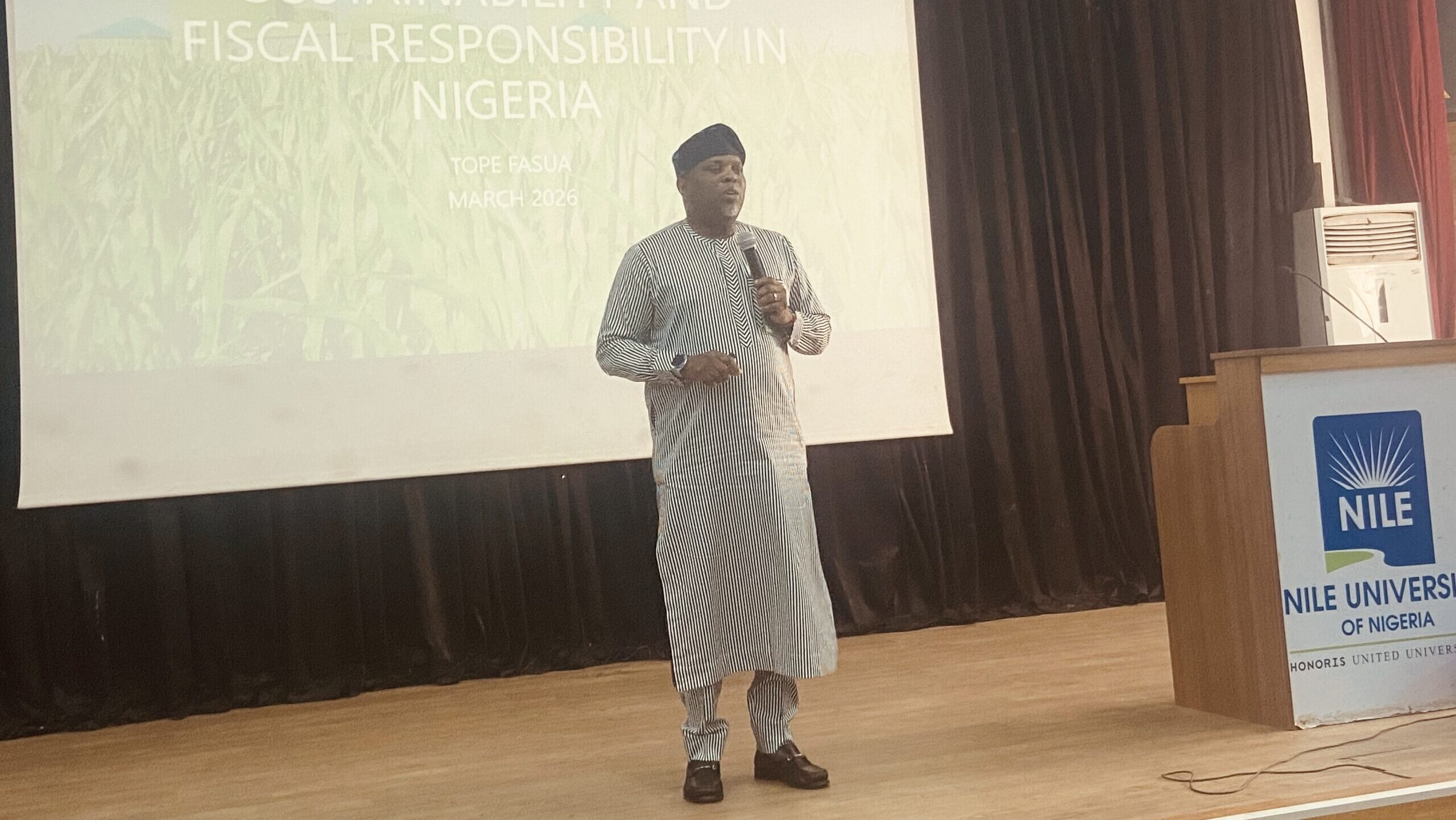
Add us on Google Tope Fasua, the special adviser to President Bola Tinubu on economic affairs, has urged Nigerian leaders to utilise government borrowing to create productive ventures that add value to the country’s economic development. He made this point while speaking at an event on Thursday at the Nile University, Abuja. The event, themed ‘Public Debt Sustainability and Fiscal Responsibility in Nigeria’, was organized by the Faculty of Arts and Social Sciences (FASS) of the university as part of its 4th annual lecture series. Details Addressing the gathering, Mr Fasua explained that responsible spending to build projects that can lead to prosperity and stand the test of time is preferable than “focusing on frivolities.” “It is better to use a government’s debt to use debts to build airports that may be useful in the future and create better job opportunities than giving people money. Countries like the US have more airports than us and they generate a big chunk of revenue from it,” he said. “It is important to note that the Federal Government alone cannot drive development. In many ways, it functions as a central coordinating body with limited direct control over land and local resources. “This raises critical questions about what state governments are doing in terms of development, what their balance sheets look like, and whether they are managing their own debts responsibly. It is easy to point fingers at the Federal Government, but development is a shared responsibility across all levels of government,” he added. The renowned economist and chief executive officer (CEO) of Global Analytics Consulting also said development of a country like Nigeria does not lie on the shoulders of the central government in Abuja alone, further calling on advocates and the citizens to also put pressure of accountability on their grassroots leaders. “It is important to note that the Federal Government alone cannot drive development. In many ways, it functions as a central coordinating body with limited direct control over land and local resources. “This raises critical questions about what state governments are doing in terms of development, what their balance sheets look like, and whether they are managing their own debts responsibly. It is easy to point fingers at the Federal Government, but development is a shared responsibility across all levels of government,” Mr Fasua said. He also noted that Nigeria sits at the lowest rung of the ladder when it comes to government borrowing compared to advanced countries such as Japan, China and the United States, saying that people should not be surprised if the nation engages in borrowing for developmental purposes in terms of social amenities. The finance expert recommended that young Nigerians, professionals, scholars and policymakers must begin to think critically about the issue of fiscal responsibility and consider the role they would play in shaping a more sustainable and prosperous economy in the nation. “Nigeria remains a work in progress. While some may argue that decades of democratic governance should have yielded more transformation, we must also recognize that progress is gradual and complex. “Fiscal responsibility is not just about limiting borrowing; it is about ensuring that borrowed funds are used effectively to drive growth and development. Nigeria’s challenge is not merely the size of its debt, but how well those resources are utilized,” he concluded. Why the lecture is important — Dean Responding to Premium Times’ questions, Jide Oladipo, the dean of FASS, stated that the lecture series is an academic forum designed to promote intellectual engagement, interdisciplinary dialogue, and knowledge dissemination within the university community and beyond. “The series brings together scholars, industry experts, policymakers, and students to discuss contemporary issues in the arts; humanities, and social sciences, serving as a platform for examining critical themes such as economic development, governance, culture, technology and social transformation,” he noted. Mr Oladipo, a professor of economics, said the series aims to bridge the gap between theory and practice by encouraging evidence-based discussions and real-world policy insights. “The initiative also supports capacity building by exposing students and early-career researchers to emerging trends, innovative ideas, and global best practices. In doing so, it enhances research visibility, fosters collaboration, and strengthens the Faculty’s contribution to national and international development discourse.” Students speak Describing the lecture as impactful, Nnanna Ohuche, a Masters student at the school’s economics department, said that the session provided him with “the intricacies and complex nature of how borrowing and debt work in the public sector.” “It was an enlightening experience and I agree that it should be held more often though, that way we can bring more experts to demystify the economy gradually,” Ohuche said. Another student, Aisha Olasope, an undergraduate student in the communications department, described the lecture as one that introduces her to different areas she could explore whenever she gets the opportunity to cover economic issues. “The lecture deepened my understanding of economics specifically on the issue of debt and taught me that governments of less-developed countries like ours engage in such debt to borrow in a bid to grow rapidly. Until this moment, I used to think otherwise,” the 300-level student noted. Share this: Click to share on X (Opens in new window) X Click to share on Facebook (Opens in new window) Facebook Click to share on WhatsApp (Opens in new window) WhatsApp Click to share on Telegram (Opens in new window) Telegram Click to share on LinkedIn (Opens in new window) LinkedIn Click to email a link to a friend (Opens in new window) Email Click to print (Opens in new window) Print