Governor under fire for visiting attack survivors in armoured tank
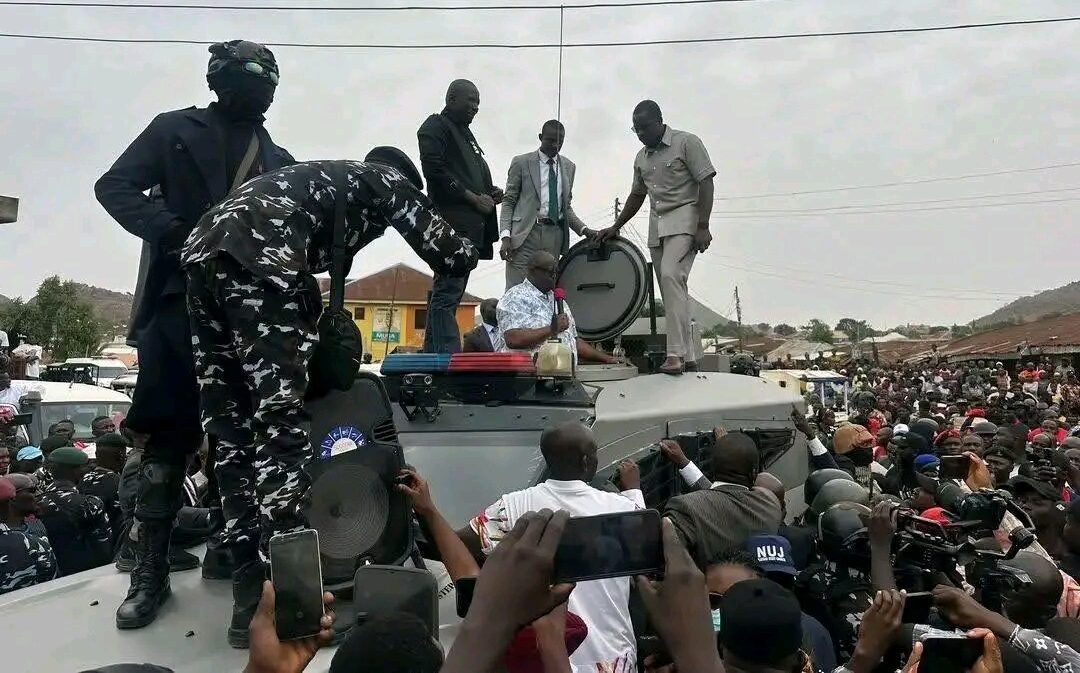
Add us on Google Plateau State Governor Caleb Mutfwang is under fire over his visit to the Angwan Rukuba community in Jos North Local Government Area, where dozens were killed on Sunday, in an armoured tank. The outrage was expressed on social media and in comments from public figures, including Babafemi Ojudu, a former senator and ex-presidential aide, who shared his views in a Facebook post monitored by PREMIUM TIMES. PREMIUM TIMES earlier reported that Mr Mutfwang visited the community following the Sunday evening attack, which residents said left scores dead, although official figures vary. The governor was driven to the beleaguered community in an armoured personnel carrier, a military-grade vehicle used in high-risk operations. He was seen standing through the roof hatch, surrounded by heavily armed security operatives, while aides stood on the vehicle. googletag.cmd.push(function() { googletag.display('div-gpt-ad-1672626398022-0'); }); Residents who spoke to PREMIUM TIMES said the governor did not step down to interact directly with them, a detail that has now become central to public criticism. “He came, but he did not come down,” one resident said. “People expected him to stand with them.” Babafemi Ojudu, in his Facebook post, described the governor’s approach as troubling, questioning the symbolism of addressing grieving residents from an armoured vehicle. “This is the height of it for me,” Mr Ojudu said. “A civilian governor addressing traumatised citizens from within an armoured tank sends a deeply troubling message. Would it not have been more honourable for him to simply step aside? In that moment, he appears to be saying: I can no longer guarantee your safety.” Public reactions Several other Nigerians also expressed their views through Facebook posts reviewed by PREMIUM TIMES. Oralu Shadrach described the scene as a symbol of the distance between leadership and the people. “The image of a governor arriving at a grieving community in an armoured tank, shielded and distant from the very people he is meant to lead, is deeply troubling,” he wrote. “At a moment when over 40 innocent lives were lost, the people deserved empathy, not a display of force.” He added that such a gesture “reinforces fear and highlights failure,” arguing that it raises questions about priorities in a state facing recurring violence. Similarly, Abraham Kyambe, also writing on Facebook, suggested the governor’s mode of visit reflected deeper political concerns. “His arrival… in an armoured tank, detached from the people he is meant to lead, is concerning,” he wrote, adding that it signals apprehension about public backlash. However, not all reactions were critical. Jackson Darman, in another Facebook post, defended the governor’s actions, arguing that security precautions in volatile environments are standard and necessary. “The use of security vehicles or armoured convoys is not an act of intimidation or insensitivity, but rather a standard precaution aimed at ensuring the safety of public officials in high-risk zones,” he wrote. He added that the focus should remain on addressing the causes of the violence rather than the optics of the visit. Security optics and public trust Security analysts say that while armoured vehicles are standard in high-risk zones, their use in moments of public grief requires careful judgement. In situations like Angwan Rukuba, where residents had just suffered loss, experts note that visible distance between leaders and victims can deepen distrust rather than reassure communities. They argue that addressing victims from within a heavily protected vehicle may convey caution, but in this context, it risks reinforcing a sense that leaders are shielded from the very insecurity citizens face daily. For communities already questioning the state’s ability to protect them, such imagery can heighten feelings of abandonment and weaken public confidence. NGOs raise concerns over killings, accountability Civil society organisations have also weighed in on the broader security situation, linking the Angwan Rukuba attack to a pattern of violence across the country. In a statement issued on 31 March, Enough is Enough (EiE) Nigeria condemned the killings and questioned the government’s capacity to protect citizens. “That is over 200 Nigerians killed in less than two months,” the group said. “And the question that demands an answer from every level of government is this: Who is protecting Nigerian lives?” The organisation described the situation as “a crisis of governance, intelligence failures, inadequate civilian protection, and a security architecture that responds to mass death rather than preventing it.” Ufuoma Nnamdi-Udeh, Executive Director of EiE Nigeria, said the government’s response to such attacks has followed a predictable pattern without accountability. ALSO READ: Plateau Killings: VDM, Mr Macaroni, others tackle Tinubu over insecurity “Every time Nigerians are killed in this way, the government responds with condolences and the promise of an investigation,” she said. “But investigations go nowhere, no one is held to account, and the attacks continue. At what point do we stop calling this a crisis and start calling it what this is — a complete government failure?” The group also criticised reliance on measures such as curfews, noting that “a 48-hour curfew is a containment measure, not a protection strategy.” NBA: Repeated attacks eroding public confidence The Nigerian Bar Association (NBA) also condemned the killings, describing the Palm Sunday attack as a stark reminder of worsening insecurity. In a statement signed by its President, Afam Osigwe, a Senior Advocate of Nigeria, the association said the recurring violence reflects a dangerous pattern of impunity. “When perpetrators of mass violence continue to evade justice, it sends a dangerous message that human life is expendable,” Mr Osigwe said. He added that the continued attacks are eroding citizens’ trust in government. “Citizens begin to lose faith in the ability of the state to protect them, and communities are left to live in constant fear,” he said. The NBA called on security agencies to “swiftly identify, apprehend, and prosecute those responsible,” while urging both federal and state governments to strengthen security presence and improve intelligence gathering. Pattern of concern The criticism also ties into broader frustrations expressed by residents in previous PREMIUM TIMES reports, where locals questioned repeated assurances from authorities after attacks. Some residents said official visits often follow a pattern of promises that do not lead to visible change in security conditions. The Angwan Rukuba attack is one of several recent incidents in Plateau State, where communities have faced recurring violence, leading to deaths, injuries, and displacement. While the governor has pledged to bring perpetrators to justice and strengthen security measures, the debate over his visit highlights deeper issues of leadership presence, public trust, and citizens’ expectations in times of crisis. Share this: Click to share on X (Opens in new window) X Click to share on Facebook (Opens in new window) Facebook Click to share on WhatsApp (Opens in new window) WhatsApp Click to share on Telegram (Opens in new window) Telegram Click to share on LinkedIn (Opens in new window) LinkedIn Click to email a link to a friend (Opens in new window) Email Click to print (Opens in new window) Print