N33.2bn Arms Funds Trial: Dasuki’s co-defendant not detained in underground cell – EFCC witness
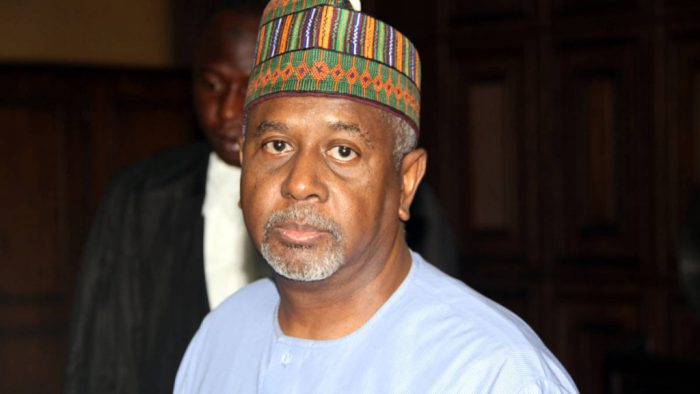
An Economic and Financial Crimes Commission (EFCC) witness has refuted the suggestion of detaining one of former National Security Adviser Sambo Dasuki’s co-defendants in an underground cell during investigations in 2015. Michael Adariku, an assistant commander 2 at the EFCC, testified on Wednesday at the FCT High Court in Abuja where Mr Dasuki and his co-defendant, Aminu Baba-Kusa, are facing prosecution on charges of diverting N33.2 billion in arms and security funds. The prosecution specially called Mr Adariku as a witness to debunk a claim that EFCC obtained several statements from Mr Baba-Kusa under duress during his detention while investigating the arms funds diversion case in 2015. Trial judge Charles Agbaza ordered a trial-within-trial to test the voluntariness of the disputed statements after Mr Baba-Kusa’s defence team objected to their admissibility. Mr Agbaza gave the order on 14 January after the defence objected to the prosecution’s attempt to tender Mr Baba-Kusa’s statements as evidence. Objecting to the admissibility of the statements, Mr Baba-Kusa’s lawyer said they were not voluntarily written by the defendant. The defence lawyer argued that a statement made by someone while being held in an EFCC underground cell could not be considered freely made. Mr Adariku, the second witness presented by the EFCC in the trial-within-trial, fielded questions under cross-examination by defence lawyer Solomon Umoh, a Senior Advocate of Nigeria (SAN), on Wednesday. Detention facility Some of the questions touched on the circumstances of Mr Baba-Kusa’s detention in EFCC custody in Abuja. Mr Umoh asked Mr Adarikun to describe the location of the cell where Mr Baba-Kusa was detained in 2015. The witness explained that the defendant was held in the cell at Idiagbon, a four-storey building in Wuse II, Abuja, which previously served as EFCC headquarters. Prosecution lawyer Oluwaleke Atolagbe earlier led the witness in his evidence-in-chief. “The cell is in the basement because of the topography of where the building is sitting. The cell is well ventilated,” the witness said. When asked if the basement was below ground level, Mr Adariku maintained that the cell was on the ground floor, attributing its appearance to the sloping nature of the terrain. A 2018 report by Daily Trust described the Idiagbon House, where the defendants were held, as a four-storey building with detention cells located in its basement. Mr Adariku’s testimony on Wednesday is similar to that of the first witness, who similarly rejected on Tuesday Mr Umoh’s description of the cell as an underground facility. The first witness, Halima Kazeem, who is an assistant commander 1 at the EFCC and the head of Mr Dasuki’s investigation, noted on Tuesday that Mr Baba-Kusa gave his statement voluntarily and was treated well in custody. Other interrogation details Mr Adariku, who responded to similar questions as those asked Ms Kazeem, said Mr Baba-Kusa reported with three persons: the financial controller and secretary of Acacia Holdings (a defendant in the case) and a lawyer. Just like Ms Kazeem maintained on Tuesday, Mr Adariku insisted that the defendant was not “induced, harassed, threatened or intimidated.” “The statement was taken in an open office,” he said. He also said Mr Baba-Kusa was detained alongside the financial controller, Attahiru Machindo, after they failed to meet EFCC’s bail conditions. However, he could not recall the details of the bail conditions. To prove the voluntariness of the statements, the witness told the court that Mr Baba-Kusa wrote his statement in the presence of individuals according to the law. But defence lawyer Mr Umoh pointed out that one of the supposed witnesses, Mr Machindo, was actually in detention alongside the defendant, rather than being an independent observer. The witness said Mr Machindo was brought out at the “instant of the second defendant (Mr Baba-Kusa) requesting that the financial controller be present.” Mr Adariku said that while Mr Machindo was detained, he could not “remember vividly if the company’s secretary, Sadia Maigari, was invited” by the EFCC. He also stated that both Messrs Baba-Kusa and Machindo were held in the same cell at Idiagbon house. READ ALSO: How ex-NSA Dasuki approved diversion of election security fund – Witness The arms diversion charges, trials Since 2015, the EFCC has prosecuted Mr Dasuki, a retired colonel, alongside Mr Baba-Kusa on 32 counts of diversion of N33.2 billion arms and security funds entrusted to the NSA office. Also facing the charges along with the two men are two of Mr Baba-Kusa’s companies – Acacia Holdings Limited and Reliance Referral Hospital Limited – which allegedly received part of the suspicious funds from the Office of the National Security Adviser (ONSA). The anti-graft agency re-arraigned the defendants in March last year after the case was reassigned to Judge Charles Agbaza. They all denied charges. So far, the EFCC has called these two witnesses to testify in the trial within trial to test the voluntariness of Mr Baba-Kusa’s statement following objections raised by his lawyers when the commission sought to tender his extra-judicial statement. But only one prosecution witness has testified in the primary trial paused to conduct the ongoing trial-within-trial. Mr Dasuki is also facing similar charges of diversion of arms and security funds before another judge of the FCT High Court in Abuja. In the case, which is before trial judge, Halilu Yusuf, EFCC accused him and his co-defendants of diverting N4.6 billion from the NSA office’s account. Share this: Click to share on X (Opens in new window) X Click to share on Facebook (Opens in new window) Facebook Click to share on WhatsApp (Opens in new window) WhatsApp Click to share on Telegram (Opens in new window) Telegram Click to share on LinkedIn (Opens in new window) LinkedIn Click to email a link to a friend (Opens in new window) Email Click to print (Opens in new window) Print