NDLEA arrests traffickers across 8 states, seizes tonnes of cocaine, cannabis, opioids
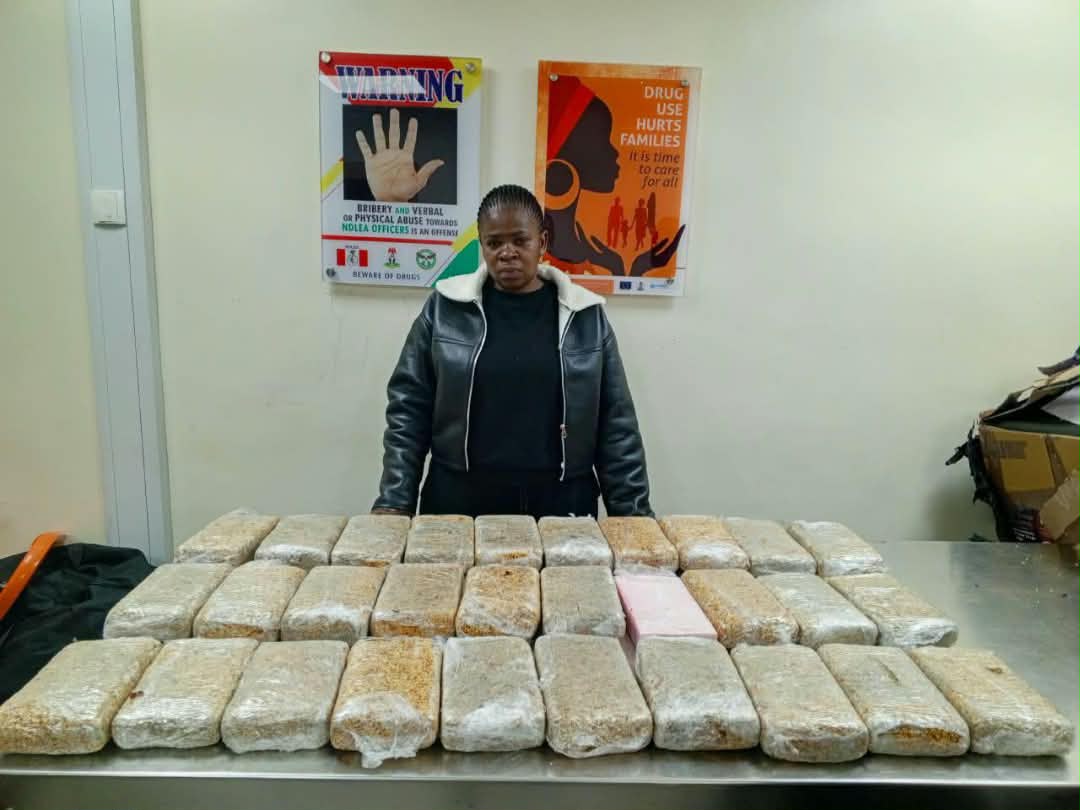
NDLEA operatives arrested a South African woman, Qhina Beauty, 34, at Murtala Muhammed International Airport on October 7 with 36.65kg of cocaine in 30 blocks wrapped in Sellotape and laced with dried pepper. She arrived September 30, recruited by another South African woman for 20,000 rand. Her Lagos contact, car dealer Uchenna Victor Umunnakwe, 46, was arrested October 14 at Apple Junction, Ago Palace Way—he admitted receiving her and arranging stays at Santiago Hotel Amuwo-Odofin and Cynarisso Hotel near the airport. Separately, Nigerian-American realtor Anetor Gloria Ubong, 62, was arrested October 21 arriving from Houston with 9.45kg of Loud cannabis concealed in gift-wrapped parcels.
Simultaneous operations across six other states yielded massive hauls: Delta (Peter Ugochukwu, 51, in Warri with 29,350 tramadol capsules, 4,116 codeine syrup bottles, 11,340 Rohypnol tablets and more; Helen Bakporo Samson, 46, with 6kg skunk), Oyo (Fajana Dada Oluwaseyi, 41, in Ibadan after 197.8kg cannabis seized from his house in September), Kano (Murtala Lawan, 30, in Gerawa with 97.2kg cannabis), Taraba (Raiyanu Misa, 39, at Lankaviri checkpoint with 60.175kg; another suspect at Dakka village with 81.49kg), Niger (Emmanuel Ekene, 26, on Sabo-Kainji Road with 64,000 opioid pills), Bauchi (Jamilu Mustapha, 45, in Ningi with 379kg cannabis). Ondo operatives found 583kg abandoned cannabis at Board-Ala farm; Edo destroyed two farms in Ugbada Forest with 2,023kg estimated yield, burning 450kg and arresting Mary Edokhai, 42, with 35kg.
This follows the July seizure of 184.5kg cocaine (est. ₦39 billion) via courier channel—the largest in NDLEA history—exposing a syndicate using Nigeria as transit from South America to Europe and Asia. Chairman Buba Marwa commended officers and urged sustained efforts. The agency's War Against Drug Abuse programme continues awareness campaigns in schools nationwide.
With trafficking networks operating across air, land, and courier channels, what community-level interventions—beyond enforcement—could meaningfully reduce local demand for these substances?