SPECIAL REPORT: AEDC officials extort Abuja residents trying to get prepaid meters
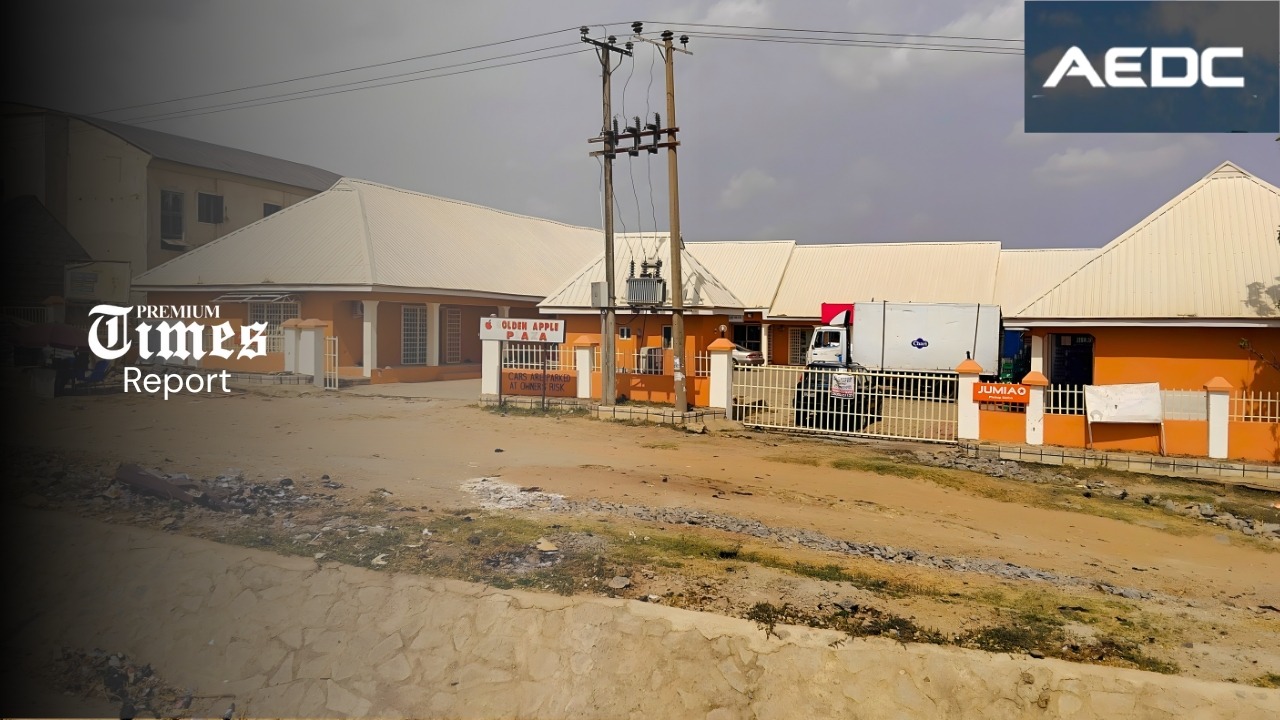
Add us on Google For three months, Felix Dauda* struggled to get his home connected to the electricity grid and obtain a prepaid meter. What was supposed to be a simple process became complex when officials of the Abuja Electricity Distribution Company (AEDC) attempted to extort him. When he visited the AEDC office in Orozo, a community in the Abuja Municipal Area Council of the Federal Capital Territory (FCT), the officials requested a N25,000 fee for a single-page form he would fill out to make the request. They told him it would cost N25,000 in Orozo and N20,000 at the Area office in Jikwoyi, another community a short distance away. “That is where I started to feel uneasy,” Mr Dauda told PREMIUM TIMES, wondering why there was a difference in cost for the same product. “When I probed further why the form costs that much, they said the company doesn’t supply them with printing machines or the paper necessary for it.” Felix registered at the Orozo AEDC branch. [Photo Credit: Popoola Ademola]The 40-year-old would later discover that the single-page form is part of a nine-page document available for free on the company’s website. When he printed the form from the website, filled it out and visited the AEDC office again in August, the officials maintained he had to pay the N25,000, this time under a different title. “They told me it covers their transport, and to settle their accountant and the manager who would sign the form after filling,” he said. Mr Dauda’s experience reflects a troubling pattern identified by PREMIUM TIMES through interviews with several victims. Those who spoke to our reporter shared stories of extortion, sowing frustration and distrust in a system meant to provide an essential service. The process vs reality According to the AEDC, the process of getting a new home connected to the electricity grid includes completing a free Supply and Agreement form, available on the company’s website. This form, which the AEDC said can also be obtained free of charge at any of its offices, was what the AEDC officials at Orozo asked Mr Dauda to pay N25,000 for. After filling out the form, AEDC officials would conduct a site verification of the house and generate a contract number and payment notification for the purchase of a meter. After payment is made, a meter is assigned to the home and installed. The meter is purchased under the Nigerian government’s Meter Asset Provider (MAP) initiative. Through the MAP initiative, the government engaged third-party vendors to provide meters to electricity consumers at a cost that will be refunded over time. However, this process appears alien to most of the residents interviewed by this newspaper. AEDC caution on their website: NOTE: This caution was not on the website as of August 2025 Apart from the initial fee for the forms, which was supposed to be free, residents interviewed in the Orozo, Kubwa, and Katampe areas of the FCT said they were also made to pay a Licensed Electrical Contractors Association of Nigeria (LECAN) registration fee. Tunde Seilman and Ruth Ajuwon in Katampe said they paid N10,000 each for the LECAN fee, while Mr Dauda paid N5,000. LENCAN is a group of professional electricians. For membership, electricians are encouraged to obtain a certificate from the Nigerian Electricity Management Services Agency (NEMSA), which comes at a cost. According to its website, the LECAN fee is not required to apply for a meter or the NEMSA certificate. Meanwhile, the AEDC said it doesn’t charge customers for LECAN fees. The company’s spokesperson, Kenechukwu Ofili, told PREMIUM TIMES that although the company recognises the association, it has nothing to do with it and does not request payment for it. “The customer is supposed to do that themselves, not AEDC. They are not to pay the money to anybody,” Mr Ofili said in a phone interview. Mr Ofili also stressed that the requirements for customers getting connected, including the forms and their processing, are free. “If you go to our website, you will see that our form clearly states that the form is not for sale, and, two, the process of that form is free, and that is the official position,” he added. Mr Dauda said he also attempted to speak with one of the company’s representatives on WhatsApp concerning the LECAN, but the official did not provide a specific registration fee for LECAN, indicating that prices vary without a clear explanation. “The person just told me the price varies, and didn’t provide any amount, even as I pressured,” he said. ‘The money is compulsory’ One Thursday morning in August, our reporter visited the AEDC Orozo office alongside Mr Dauda. What unfolded was a brazen attempt at extortion by AEDC officials. Even after completing the application, one of the staff members who attended to us insisted that we pay LECAN N5,000 and another N20,000, which she said would cover her transport and also settle her boss and the people who would sign and generate the account. “The money is compulsory. They said it is free (referring to the company policy), but if you don’t do their thing here, the people at Jikwoyi will just drop your file. And if you keep going, they tell you it is network issue, you should come back. They will never do it,” the staff member, who declined to provide her name, told our reporter. After some negotiation, she agreed to collect a total of N20,000 instead of N25,000. She said the N20,000 would cover LECAN and the settlement. (The conversation) Dauda’s ordeal is not an isolated case. Inside the AEDC branch office at Living Faith Junction, Orozo, Abuja. [Photo Credit: Popoola Ademola] More frustration For Mr Seilman, a homeowner at Katampe, getting connected and obtaining meters took two years of extortion and frustration. Mr Seilman said he was extorted by a staffer at the AEDC in 2022, who told him the government was about to distribute new prepaid meters to Nigerians. “He told me that I should register because only registered people would be given. Then he said I would be paying N8,750 for seven meters,” he recalled. Mr Seilman paid the money for two months, estimated at N122,500. Three months later, another official, whom he said was a friend, told him to stop the payment, saying the initiative wasn’t genuine. He was forced to start registration afresh, delayed for another month, before he secured the seven meters for his homes. “I had to start a fresh registration. I think I paid N10,000 for the LENCAN. I can’t remember how much I paid for the form again. But I paid a certain amount. Unfortunately, the new meters they supplied came with debt. We discovered that they are removing 50 per cent, 25 per cent on the meters,” he added. Mr Seilman’s complaints to the AEDC yielded little response, leaving him without resolution after two years of persistent follow-up, forcing every tenant to pay the money. “They told me it was a mistake that they had written to the head office,” he said. One of his tenants who was affected by the illegal bill, Akinola Oyewole, further revealed that Mr Seilman was told at the AEDC office in Katampe that the meter started reading at the point of purchase, even without being connected to the grid. “So, he went to AEDC, and they told him that the meter that we installed started reading the moment he purchased the meters. That doesn’t make sense at all,” Mr Oyewole added. Ruth Ajuwon, a resident of Kubwa, was frustrated last year till she abandoned the process. She said she was consistently asked to pay several charges without knowing what they were for. After visiting the office several times without an expected result, she stopped and started saving for an alternative. “They mentioned that LENCAN too, and several other things, amounting to N100,000 plus. I was visiting them as if I were begging. So I decided to get Solar energy.” The difficulty and corruption Nigerians encounter in obtaining prepaid meters are among the numerous challenges in Nigeria’s energy sector. Aside from the frequent grid collapses that cause blackouts affecting households and businesses, this series of extortions has also led to distrust and frustration among energy consumers. AEDC speaks When contacted, Mr Ofili said the company is looking into a new method in which customers will download the form from its website, fill it out, and send it back on the platform without approaching any offices. “Soon our customers will be able to do everything online. Including submitting the form online instead of taking it to any branch,” he said. He added that the office is willing to look into the matter and ensure their customers are being treated upright. “Please send me all the evidence so we can also do our investigation,” he concluded. READ ALSO: AEDC reports power outage due to national grid disruption Metering initiative In 2020, the Nigerian government commenced the National Mass Metering Programme (NMMP) to increase the metering rate and reduce metering gaps in the country. This, according to the government, would also eradicate arbitrary estimated billing, strengthen the local meter manufacturing sector, create jobs, and reduce collection losses. The Nigerian government, through a partnership with the Central Bank of Nigeria (CBN), invested N200 billion in the program and subsequently engaged the nation’s electricity Distribution Companies (DisCos) and Meter Asset Providers (MAPs). Access to Electricity Meanwhile, about 39 per cent or 86.8 million Nigerians lack access to electricity, the largest electricity deficit in the world, according to the World Bank.. These discouraging experiences are forcing many Nigerians to consider costlier alternatives like generators and solar. A 2021 report by the National Bureau of Statistics revealed that generators powered by petrol, diesel, and gas provide 48.6 per cent of the electricity consumed by power users across the country, while Nigerians spend approximately $14 billion annually to fuel their generators. A screenshot from the AEDC website Share this: Click to share on X (Opens in new window) X Click to share on Facebook (Opens in new window) Facebook Click to share on WhatsApp (Opens in new window) WhatsApp Click to share on Telegram (Opens in new window) Telegram Click to share on LinkedIn (Opens in new window) LinkedIn Click to email a link to a friend (Opens in new window) Email Click to print (Opens in new window) Print