The Complete Guide to the ATF AI Challenge: How Nigerian Students Can Lead the AI Revolution

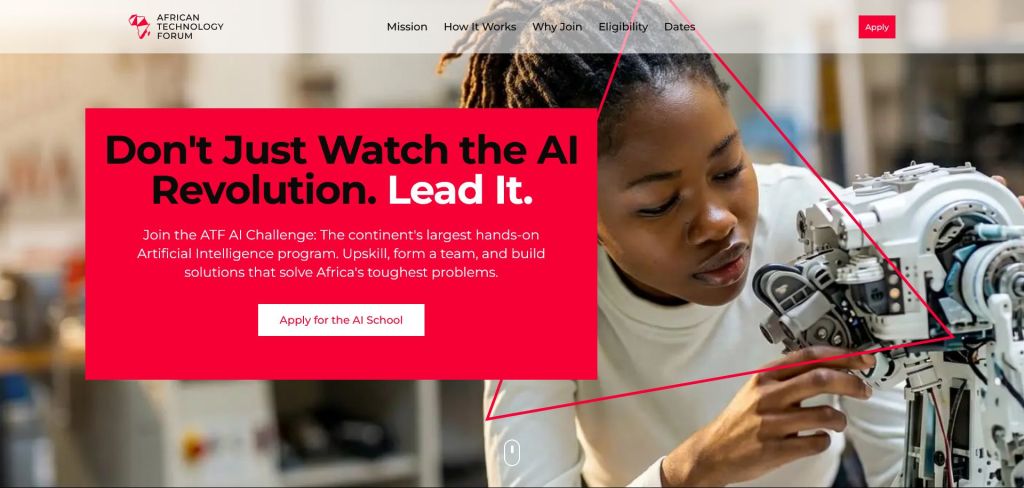
The Complete Guide to the ATF AI Challenge: How Nigerian Students Can Lead the AI Revolution
Between 2025 and 2030, Artificial Intelligence is projected to add $15 billion to the Nigerian economy. For a student in Akure or a recent graduate in Ado-Ekiti, this isn't just a headline—it is the most significant career signal of the decade.
The "japa" wave has seen thousands of Nigeria's brightest minds move abroad to find high-value tech roles. However, a new infrastructure is being built at home that allows you to earn global-tier value while solving local problems. The African Technology Forum (ATF) AI Challenge, backed by a $1 million grant from Google.org, is that infrastructure. This program isn't just another "coding bootcamp"; it is a massive, multi-stage talent pipeline designed to move 10,000 young Africans from basic literacy to high-paying careers and startup founders.
In this deep dive, we break down everything you need to know about the ATF AI Challenge—from the MIT roots of its founders to the specific steps you need to take at FUTA, EKSU, or ABUAD to ensure you aren't left behind.
What You'll Learn
- What is the ATF AI Challenge?
- Why This Matters for Akure and Ekiti Students
- The Three-Pillar Model: Learn, Build, Launch
- Eligibility: Who Can Join?
- The Omnific Works & GistCaster Connection
- How to Apply and Maximize Your Chances
- The Impact: Jobs, Funding, and MVPs
- Frequently Asked Questions
What is the ATF AI Challenge?
The ATF AI Challenge is a pan-African initiative funded by Google.org to train 10,000 young people in Nigeria, Ghana, Kenya, and South Africa to build local, AI-powered solutions.
Founded at the Massachusetts Institute of Technology (MIT) in 1988, the African Technology Forum (ATF) has spent nearly 40 years ensuring that African scientists and engineers are not just spectators in the global tech race. This specific AI Challenge, launched with a $1 million funding injection, addresses what experts call the "Last Mile" problem in African education: the gap between knowing how to code and knowing how to build a product that a company will pay for.
Unlike generic online courses, the ATF AI Challenge is structured as a "hands-on engine." It provides the curriculum, the mentorship, the compute power (API credits), and the direct link to employers. For the Nigerian cohort, this program is a cornerstone of the national strategy to create one million digital jobs.
Why This Matters for Akure and Ekiti Students and Recent Graduates
For students in Akure and Ekiti, the ATF AI Challenge offers a rare bridge between academic theory and the high-demand global AI market.
While Lagos is often cited as Nigeria’s tech hub, the intellectual engine of the Southwest often sits in the "Knowledge Zone" of Ekiti and the "Tech Capital" of Akure. Institutions like the Federal University of Technology, Akure (FUTA) have long been the bedrock of Nigerian engineering. However, the disconnect between classroom theories and industry-standard tools like Applied LLMs (Large Language Models) or Git-based collaboration can be a barrier.
The Opportunity in Akure (FUTA)
FUTA students are already known for technical rigor. The AI Challenge allows you to take that engineering foundation and apply it to the $15 billion AI economy. Whether you are in Computer Science, Agricultural Engineering, or Physics, the ability to build a functional AI MVP (Minimum Viable Product) puts you years ahead of your peers in the job market.
The Opportunity in Ekiti (EKSU, ABUAD, FUOYE, BOUESTI)
Ekiti State is positioning itself as a "Knowledge Zone." With the Afe Babalola University (ABUAD) medical and agricultural excellence, and the rising research profile of Federal University, Oye-Ekiti (FUOYE), there is a massive opportunity to use AI to solve local problems.
- Agriculture: Building AI to detect crop diseases in Ekiti’s cocoa farms.
- Health: Using AI to assist in diagnostics at ABUAD’s multi-system hospital.
- Education: Creating LLMs that can tutor students in local dialects or simplified English.
The ATF AI Challenge is specifically looking for these types of context-driven solutions.
The Three-Pillar Model: Learn, Build, Launch
The program runs from 2025 to 2027 and is divided into three distinct phases. You cannot skip steps; each pillar is designed to filter for the most dedicated talent.
Pillar 1: LEARN (The AI School)
DIRECT ANSWER: The AI School is a 4-week virtual intensive that covers the foundational stack of modern AI: Python, Git, and Applied LLMs.
This stage is open-access. ATF expects to register between 12,500 and 15,000 young Africans for this phase.
- What you’ll learn: You won't just learn "what AI is." You will learn how to use Python to interact with data, how to use Git for version control (essential for any pro developer), and how to build applications using Large Language Models (the tech behind ChatGPT).
- The Goal: To identify the "high-potential" talent ready for the next level.
Pillar 2: BUILD (The AI Challenge)
DIRECT ANSWER: In the Build phase, 10,000 selected participants form 2,500 multidisciplinary teams to create AI-powered solutions for real-world problems.
This is where the "Challenge" truly begins. This isn't a solo effort. You will be paired with others to form teams.
- Support Provided: ATF and Google.org provide the "heavy lifting" tools. This includes API/compute credits and cloud resources. In the real world, running AI models is expensive; here, it is funded.
- Mentorship: You get a technical mentor (to help with code) and a domain expert (to make sure your solution actually works for doctors, farmers, or bankers).
- Target: 1,000+ functional MVPs in Health, Agriculture, Finance, and Education.
Pillar 3: LAUNCH (Demo Days)
DIRECT ANSWER: The top 500 teams from across the continent will travel to regional hubs (like Lagos) to pitch their solutions to investors and employers.
This is the finish line. The goal of the Launch phase is not just a certificate—it is employment or funding.
- Career Advancement: At least 25% of participants are expected to secure new jobs or internships within six months.
- Startup Seeding: For teams that build truly innovative solutions, this is the chance to meet seed investors who can turn your MVP into a registered company.
Eligibility: Who Can Join?
The ATF AI Challenge is designed specifically for university undergraduates and young professionals who graduated within the last three years.
ATF is very intentional about this demographic. They are looking for "early-career" talent who have the time to learn and the drive to build.
- Undergraduates: Whether you are in 100 level or final year, as long as you are currently enrolled in a recognized university (like FUTA, EKSU, FUOYE, etc.).
- Recent Graduates: You must have graduated within 3 years of the application date. This means if you finished your NYSC in 2023, 2024, or 2025, you are perfectly positioned.
- Gender Target: ATF has a 40% female participation guarantee. This is a massive call to action for female students in Akure and Ekiti to apply. The program is designed to be inclusive and supportive of women in tech.
- Skill Level: You don't need to be an AI expert to start. You just need a foundational interest in technology and a problem-solving mindset.
The Omnific Works & GistCaster Connection
GistCaster’s parent company, Omnific Works, has signed a Memorandum of Understanding (MoU) with the African Technology Forum (ATF) to help drive this initiative.
Why does this matter to you? GistCaster isn't just "reporting" the news; we are part of the infrastructure helping to bring these opportunities to your doorstep. Our mission is to ensure that West Africans have the intelligence they need to innovate.
Through this partnership, we will be providing:
- Updates on application windows.
- Tips on how to succeed in the AI School.
- Spotlights on successful teams from the Akure and Ekiti axis.
We believe that by providing this deep-form intelligence, we can help move our readers from "hearing about AI" to "building AI."
How to Apply and Maximize Your Chances
The first step is to register for the first cohort of the AI School, which opens in the second quarter of 2026.
The Sign-Up Link
You can register your interest and join the pipeline here: https://bit.ly/atfxw3
3 Tips for a Winning Application:
- Be Specific About a Problem: Don't just say you want to "learn AI." Mention a local problem. Example: "I want to use AI to help Ekiti farmers predict rainfall patterns more accurately to improve crop yield."
- Highlight Collaborative Potential: Mention any previous group projects or student associations you’ve been part of (like Google Developer Student Clubs in FUTA).
- Stay Updated: Since the program is funded by Google.org, follow Google’s Africa blog and the ATF social media handles for official date announcements.
The Impact: Jobs, Funding, and MVPs
By the end of the 2025–2028 cycle, the ATF AI Challenge aims to have trained 10,000+ Africans and launched 1,000+ functional AI products.
The program is backed by $1 million from Google.org for a reason: Google sees Nigeria as a primary hub for the future of AI. With AI expected to add $15 billion to our GDP by 2030, the skills you learn here are literally the "currency" of the next decade.
Key Success Targets:
- 1,000+ MVPs: Real software, not just ideas.
- 25% Employment Rate: Direct transition into the workforce.
- Institutional Adoption: 50–100 of the solutions built by students will be piloted by hospitals, schools, or government agencies.
Imagine a solution built by a team at FUOYE being adopted by the Ekiti State Ministry of Health. That is the level of impact this program is designed to create.
The Gist: Key Takeaways
- What: A $1M Google.org-funded AI talent pipeline for students and recent grads.
- Who: Open to undergraduates and grads within 3 years (40% female target).
- Where: Specific focus on Nigeria (including Akure and Ekiti).
- How: A 3-stage process: Learn (AI School), Build (Challenge), and Launch (Demo Day).
- Action: Apply/Register at https://bit.ly/atfxw3.
Frequently Asked Questions
Is the ATF AI Challenge free?
Yes. The program is fully funded by Google.org. There are no tuition fees for the AI School or the Challenge phase. However, you will need access to a computer and internet connectivity for the virtual components.
Do I need to be a Computer Science student to apply?
No. While technical skills are helpful, the "BUILD" phase requires multidisciplinary teams. If you are a student of Agriculture, Finance, or Medicine, your domain expertise is essential for building an AI solution that actually works in those fields.
What is the time commitment for the AI School?
The AI School (Pillar 1) is a 4-week virtual intensive. You should expect to dedicate about 10–15 hours per week to master the foundations of Python, Git, and LLMs.
Will I get a certificate?
Yes, participants who complete the AI School and the Challenge stages will receive certifications backed by ATF and its partners. However, the real prize is the Demo Day where you can secure jobs or funding.
Does the program help with "Japa"?
The program is designed to build the Nigerian digital economy. However, the skills you learn (AI, Python, Git) are globally recognized. Whether you choose to build a startup in Akure or work for a global firm remotely from Ekiti, these skills make you globally competitive.
Conclusion
The ATF AI Challenge is more than a competition; it is a declaration that the next generation of AI innovators will come from places like Akure and Ado-Ekiti, not just Silicon Valley. With the backing of Google.org and the 37-year legacy of the African Technology Forum, the infrastructure is now in place.
For the FUTA student in the lab tonight, or the EKSU graduate wondering what comes after NYSC: the gap between "potential" and "impact" has just been bridged. The only question is whether you will walk across it.
Register now at https://bit.ly/atfxw3 and start building Nigeria’s AI-powered future.
This article was produced by GistCaster. GistCaster is committed to bringing the gist to you.
Last Updated: May 2026 Disclaimer: The ATF AI Challenge is a third-party program. While GistCaster/Omnific Works is a partner, all final admissions and funding decisions are made by the African Technology Forum and its primary funders. Always verify dates and requirements on official ATF platforms.